Why Employers Should Be Paying Attention
When leaders think about respiratory health at work, they think about flu vaccination days, air quality, and the annual winter absence spike. Almost none think about their employees' oral health. Yet respiratory physicians, periodontal researchers and infection-control specialists increasingly do.
This is Report 5 in the Smile™ Enterprise Oral Health Series. Reports 1 to 4 covered heart disease, cancer, mental health, and diabetes. This report covers respiratory health — six conditions, from pneumonia to obstructive sleep apnoea, each linked in the research literature to the state of a person's mouth.
It is also the report where the connection is easiest to picture. Most of the links in this series run through the bloodstream and take years to build. This one is partly mechanical: what lives in the mouth gets breathed in. That makes it the most intuitive link in the series, and one of the few where the evidence includes controlled trials of an intervention.
One Preventable Condition, More Than 50 Linked Chronic Conditions
Poor oral health is linked to more than 50 chronic conditions. The following conditions are the most significant for Australian workforces, and each has, or will have, its own report in this series — this report covers respiratory health.
Six Conditions, Three Routes
Below is the whole report in one table: six respiratory conditions, what the research associates each one with, and how strong that evidence actually is. Everything that follows is this table, explained.
How to Read the Grades
- STRONGMeans consistent association across study designs plus intervention trials.
- MODERATEMeans consistent association across several meta-analyses, with real limitations — cross-sectional designs, shared risk factors such as smoking, or an unresolved direction of effect.
- EMERGINGMeans a genuine signal that is not yet settled or is contradicted.
We grade rather than list flat because the pneumonia evidence and the asthma evidence are not comparable, and presenting them as though they were would not survive scrutiny.
| Condition | Evidence | What the research associates it with | Anchor source |
|---|---|---|---|
| Pneumonia (incl. aspiration pneumonia) | STRONG | Oral bacteria aspirated into the lungs; poor oral hygiene is a documented risk factor for aspiration pneumonia, and professional oral care reduced pneumonia deaths in randomised trials | Sjögren 2016; Kaneoka 2015; Omer 2026 |
| Respiratory tract infections (incl. COVID-19 severity) | MODERATE | Dental plaque acts as a reservoir for respiratory pathogens; poor oral health associated with 3.5× the odds of ICU admission and 4.6× the odds of needing a ventilator with COVID-19 | Marouf 2021; Molina 2023 |
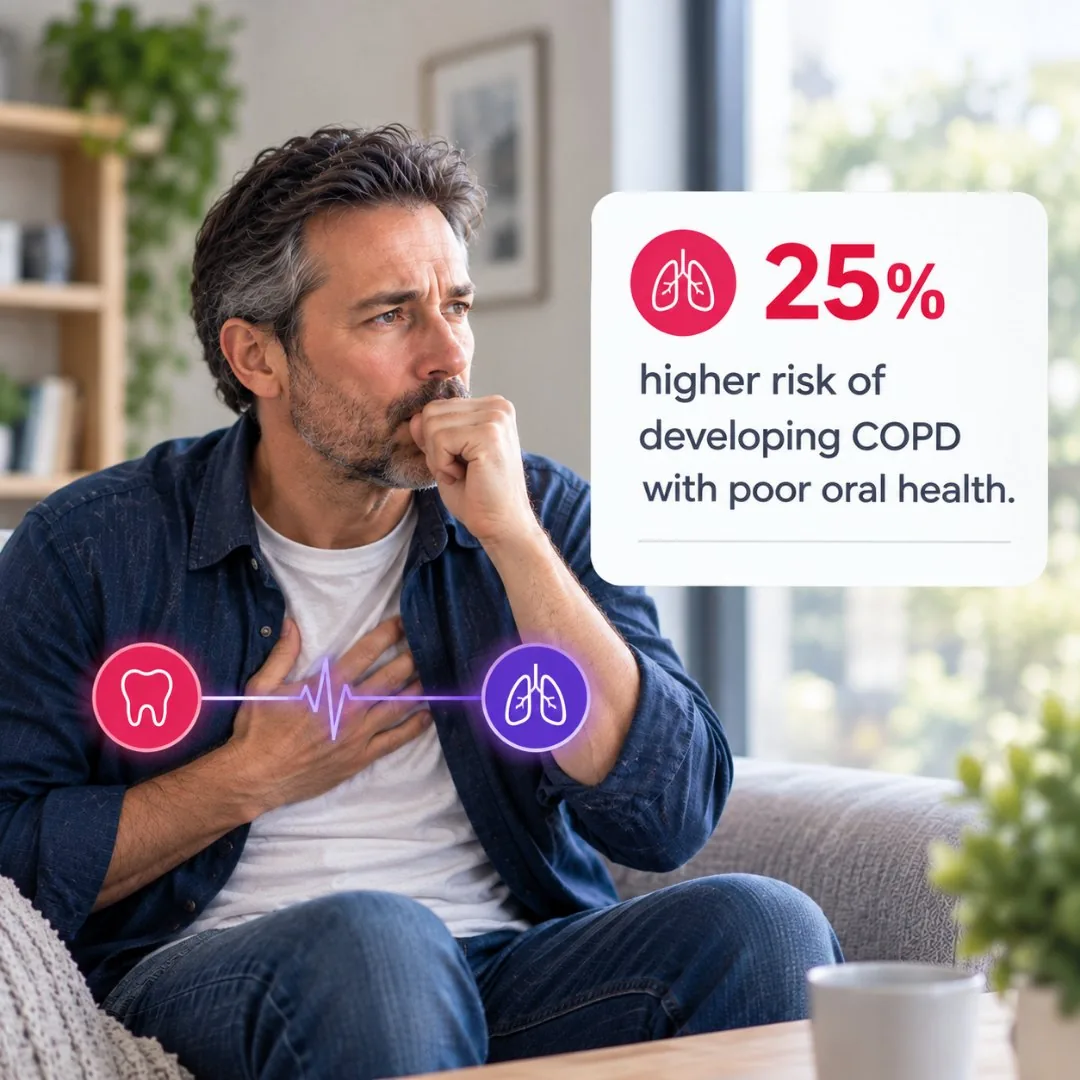
| COPD | MODERATE | Poor oral health associated with 25% higher risk of developing COPD over 12.7 years; pooled odds 1.28–1.42; smoking is a shared cause and is not always adjusted for | Wang 2024 (UK Biobank); Molina 2023 |
| Chronic respiratory disease (the NCD category) | MODERATE | Across 14 meta-analyses and 500,000+ people, poor oral health associated with 2.45× the odds of respiratory disease overall — with high heterogeneity | Omer 2026 |
| Obstructive sleep apnoea | MODERATE | Poor oral health associated with 1.65× the odds of OSA; the direction is unresolved, and mouth-breathing and dry mouth run the other way | Molina 2023 |
| Asthma | EMERGING | Contested for poor oral health itself — one review finds no significant association, another finds a strong one. Well established for what inhalers do to the mouth: dry mouth, decay, thrush | Molina 2023; Moraschini 2018; Gani 2020 |
Those six conditions sort into three routes between the mouth and the lungs. Each route gets its own section.
Down the Airway
This is the most direct link in the entire Oral Health Series. The mouth is not sterile. Dental plaque is a dense bacterial film, and in untreated poor oral health it is also a reservoir for the bacteria that cause chest infections. Every day, small amounts of saliva and plaque are inhaled or aspirated. A healthy immune system clears them. When the bacterial load is high, or the person is unwell, older, or asleep, it does not always manage to.
Here are the two conditions on this route, in turn.
Pneumonia, Including Aspiration Pneumonia
STRONG▼
Infection of the lungs. Aspiration pneumonia is the form caused by breathing in material from the mouth or throat — and the bacteria involved are, very often, oral bacteria. Respiratory conditions were the principal diagnosis in 521,000 Australian hospitalisations in 2023–24.
The oral link: In nursing home residents, inadequate oral care was one of only two modifiable factors independently associated with developing aspiration pneumonia, at 1.6 times the risk. People with deep gum pockets around ten or more natural teeth showed 3.9 times the risk of dying from pneumonia. An umbrella review pooling 14 meta-analyses put poor oral health at 2.7 times the odds of pneumonia overall. And — the reason this condition is graded Strong — professional oral care reduced pneumonia deaths in randomised trials (Section V).
Pneumonia in a healthy 35-year-old is uncommon. Pneumonia in an employee's ageing parent, or in a child, is not — and the aged-care evidence lands squarely on the carer generation. The oral route also matters for anyone in a workforce with a respiratory condition, a weakened immune system, or a hospital stay ahead of them.
Respiratory Tract Infections, Including COVID-19 Severity
MODERATE▼
The everyday chest and throat infections — bronchitis, influenza-related infection, and the pneumonias that follow viral illness — plus, since 2020, COVID-19. These are the respiratory events a workforce actually experiences, every winter.
The oral link: The same plaque-as-reservoir mechanism applies: oral bacteria colonise the airway and turn a viral infection into a bacterial one. The clearest recent evidence is from COVID-19. In a case–control study of 568 patients, those with poor oral health had 3.5 times the odds of intensive care admission, 4.6 times the odds of needing a ventilator, and higher blood markers of inflammation. A 2023 meta-analysis pooled the ventilation finding at 6.2 times the odds and COVID-related death at 2.3 times.
Respiratory infection is the most common reason for short-term sick leave in any workforce. The evidence here does not say poor oral health causes the infection; it says that when infection arrives, the person with an inflamed, bacteria-laden mouth tends to have a harder time of it. A follow-up study makes that practical: people whose poor oral health had been treated did not carry the same excess risk of ventilation (Section V).
One figure anchors this route:
The odds of needing a ventilator with COVID-19 for patients with poor oral health compared with those without, after adjusting for age, sex, weight, smoking, diabetes and heart disease. ICU admission: 3.5×.
Marouf et al., Journal of Clinical Periodontology (2021), 568 patients
Through the Bloodstream
The second route is the one readers of Reports 1 to 4 will recognise. Poor oral health is a chronic inflammatory condition with, at its worst, an inflamed surface inside the mouth the size of a palm. Inflammatory mediators enter the bloodstream continuously. In the lungs, that body-wide inflammation adds to the local inflammation that drives long-term airway disease.
This route also carries the biggest complication in the report, and it is worth naming up front: smoking. Smoking is the leading cause of COPD and a major cause of poor oral health. Some of the association between the two is simply smoking showing up twice. The better studies adjust for it, and the association survives — smaller, but still there. Not all studies adjust, which is why COPD is graded Moderate rather than Strong.
Here are the two conditions on this route.
Chronic Obstructive Pulmonary Disease (COPD)
MODERATE▼
Long-term narrowing of the airways — emphysema and chronic bronchitis — that develops over many years. In 2022, 4.8% of Australians aged 45 and over, around 496,000 people, were living with COPD.
The oral link: The largest prospective evidence is from UK Biobank: among 379,266 people followed for a median of 12.7 years, those with poor oral health had a 25% higher risk of developing COPD. Cross-sectional and case–control meta-analyses put the odds at 1.28 to 1.42 times, and at 1.78 times where gum attachment loss is measured directly. A small number of intervention studies suggest periodontal treatment may reduce COPD flare-ups and improve lung function, but the trials are small and the evidence is not yet settled.
COPD arrives in the senior half of a workforce — the people carrying the most institutional knowledge. It presents as breathlessness, reduced stamina and repeated winter chest infections long before it presents as a diagnosis, which makes it a presenteeism condition first and an absence condition later.
Chronic Respiratory Disease — The Broad NCD Category
MODERATE▼
The World Health Organization counts chronic respiratory disease as one of the four major non-communicable diseases, alongside cardiovascular disease, cancer and diabetes. In Australia, 34% of the population — around one in three — was living with a chronic respiratory condition in 2022, up from 31% in 2001. Respiratory conditions were involved in 28% of all deaths in 2023 and accounted for $5.8 billion of health-system spending in 2023–24.
The oral link: A 2026 umbrella review pooling 14 meta-analyses and more than 500,000 participants found poor oral health associated with 2.45 times the odds of respiratory disease overall. The heterogeneity between studies was high, which is the reason we quote the figure with that caveat attached and do not use it as the report's headline.
One in three employees, by prevalence. Most chronic respiratory conditions are managed rather than cured, which means the employer is not waiting for a diagnosis — it is already supporting a workforce in which a third of people carry one.
The figure worth holding onto from this route is the prospective one — it is the same figure that carries this report's card in the series grid:
The higher risk of developing COPD associated with poor oral health, among 379,266 UK Biobank participants followed for a median of 12.7 years.
Wang et al., Journal of Clinical Periodontology (2024)
Back Into the Mouth
The third route runs the other way. For asthma and sleep apnoea, the strongest and best-understood link is not that the mouth damages the lungs — it is that the condition, and the way it is treated, damages the mouth. That matters for an employer because these are the two respiratory conditions most likely to be sitting in a working-age employee right now, and because the damage is exactly the kind routine dental care catches early.
Here are the two conditions on this route.
Asthma
EMERGING▼
Chronic inflammation and narrowing of the airways. Around 2.8 million Australians — 11% of the population — were living with asthma in 2022, and unlike COPD it is spread across the whole working-age range.
The oral link: This is the most contested condition in the report, and we are stating that plainly. A 2023 meta-analysis commissioned by the European Federation of Periodontology found no statistically significant association between poor oral health and asthma. A 2026 umbrella review found a strong one. Two earlier reviews found more gum inflammation in people with asthma, without settling why. What is not contested is the medication effect: inhaled corticosteroids and bronchodilators reduce saliva flow and lower the pH of the mouth, and reviews consistently report higher rates of dry mouth, tooth decay, enamel erosion and oral thrush among regular inhaler users.
One in nine employees, by prevalence. The practical point for an employer is not the contested gum-disease link. It is that a large, working-age group is on daily medication with known oral side effects, and that the fix — routine annual check-ups, fluoride, and a rinse after each inhaler use — is inexpensive and sits entirely inside routine dental care.
Obstructive Sleep Apnoea (OSA)
MODERATE▼
Repeated collapse of the upper airway during sleep, cutting off breathing for seconds at a time, many times a night. It is estimated that around 20% of Australian adults have at least moderate OSA and 4% have symptomatic OSA; one Australian study estimated that one in ten Australians has undiagnosed OSA. It presents in the daytime as fatigue, poor concentration and sleepiness.
The oral link: The 2023 EFP meta-analysis found poor oral health associated with 1.65 times the odds of OSA, across six studies. The direction is unresolved: OSA causes mouth-breathing and dry mouth, which promote plaque and gum inflammation; gum inflammation may in turn add to the systemic inflammation seen in OSA. OSA also leaves physical marks in the mouth — tooth wear from night-time grinding, a scalloped tongue, a dry morning mouth — that a dentist is often the first clinician to notice. And one first-line treatment for mild-to-moderate OSA, the mandibular advancement splint, is made and fitted by a dentist.
Untreated OSA is a presenteeism and safety condition: the employee is at their desk, or behind the wheel, running on fragmented sleep. Because so much of it is undiagnosed, the annual dental visit is one of the few routine touchpoints where the signs can be picked up and a referral made.
The figure worth holding onto from this route:
The odds of obstructive sleep apnoea associated with poor oral health, pooled across six studies. One in ten Australians is estimated to have undiagnosed OSA.
Molina et al., Journal of Clinical Periodontology (2023); Senaratna et al., BMC Public Health (2016)
What Happens When the Mouth Is Cleaned
Everything to this point has been observational. This section is not.
Because the down-the-airway route is physical, it can be tested directly: reduce the bacterial load in the mouth and see whether fewer people get pneumonia. That experiment has been run, repeatedly, in the settings where pneumonia is most dangerous — hospitals and aged-care homes — and pooled in systematic reviews of randomised controlled trials.
The reduction in deaths from healthcare-associated pneumonia among older adults when oral care was delivered by dental personnel, pooled across randomised controlled trials (risk ratio 0.43).
Sjögren et al., Journal of the American Geriatrics Society (2016)
A separate meta-analysis of trials in non-ventilated hospital and nursing-home patients found oral care reduced pneumonia by 39% (risk ratio 0.61), and fatal pneumonia by 59% where the oral care was mechanical cleaning rather than a mouthwash alone. The authors note the included trials carried a high risk of bias, and we pass that caveat on.
The COVID-19 evidence adds a second, more recent, data point. In a follow-up to the study quoted in Section II, covering 1,325 patients, people with untreated poor oral health had 3.9 times the odds of needing mechanical ventilation compared with periodontally healthy patients — while people whose poor oral health had been treated did not carry a significant excess risk (1.28 times, not statistically significant). Treated patients also had lower blood levels of D-dimer and ferritin, two markers of the inflammatory response that drives severe COVID-19.
What the Trials Do and Do Not Show
Because these findings will be quoted, it is worth being precise about their edges. The table below states them plainly.
| What the evidence shows | What it does not show | Why we are saying so |
|---|---|---|
| Professional oral care reduced pneumonia, and pneumonia deaths, in randomised trials among older adults in hospitals and aged care. | That the same effect size applies to a healthy working-age population. Those trials have not been run. | The mechanism is the same in every mouth; the baseline risk is not. Overclaiming here would lose a clinically literate reader. |
| The effect was strongest when care was delivered by dental personnel and included mechanical cleaning. | That a mouthwash alone is enough — the nursing-delivered and mouthwash-only arms were weaker or non-significant. | This is the argument for professional dental care, not for a product on the bathroom shelf. |
| Treated poor oral health did not carry the excess COVID-19 ventilation risk that untreated poor oral health did. | Causation — this is one case–control study, not a trial, and it is graded accordingly. | It is included because it is the only evidence in the respiratory literature comparing treated with untreated poor oral health in adults. |
| Small studies suggest periodontal treatment may reduce COPD flare-ups and improve lung function. | Anything settled. The trials are few, small, and methodologically limited. | We flag it as promising and leave it there. |
Why this matters for the rest of the report: The pneumonia trials are the proof of mechanism. They show that what lives in the mouth reaches the lungs, and that removing it changes what happens in the lungs. Every other association in this report sits on top of that demonstrated route.
Where It Lands
Respiratory risk is not spread evenly across a workforce, and it does not arrive through one door. The table below puts the six conditions against the groups of employees they land on, and what each one looks like from the employer's side.
| Who | What is happening | What it looks like to the employer |
|---|---|---|
| Everyone, every winter | Respiratory tract infections. A bacteria-laden mouth is associated with worse outcomes once infection arrives. | The annual winter absence spike, and the colleagues working through a chest infection at reduced capacity. |
| Roughly one in nine employees | Asthma, on daily inhaled medication with known effects on the mouth: dry mouth, decay, erosion, thrush. | Nothing visible — until the dental problem becomes the reason for a day off, or a lost tooth in a client-facing role. |
| Roughly one in five adults | Obstructive sleep apnoea, most of it undiagnosed. Fragmented sleep, night-time grinding, dry mouth. | Fatigue, reduced concentration and safety risk — presenteeism that looks like disengagement. |
| Employees aged 45 and over | COPD developing over years; poor oral health associated with 25% higher risk of developing it. | Breathlessness and repeated chest infections in the most experienced people — capacity lost before any diagnosis. |
| Parents and carers | Aspiration pneumonia in ageing parents; respiratory infection in children. Oral care is a modifiable risk factor for the former. | Carer's leave, and the parental absence that never appears as the employee's own sick leave. |
| Anyone facing a hospital stay | Healthcare-associated pneumonia. Professional oral care reduced deaths from it by 57% in randomised trials. | Longer recoveries and longer absences after planned surgery. |
The point of this table is reach, not fear. No single respiratory condition touches a whole workforce. Together, through six different doors, they touch nearly all of it — and every door has the same modifiable factor on the mouth side of it.
What Each Side Reveals About the Other
Because the routes run in both directions, so do the warning signs. The mouth can raise a flag about the airway, and a respiratory condition — or its treatment — leaves marks in the mouth. Neither column is diagnostic. Both are reasons to see a dentist or a GP.
Signs in the Mouth That May Point to Respiratory Trouble
Signs That a Respiratory Condition Is Affecting the Mouth
Everyone's Benefits Stack Looks Like Everyone Else's
Australian employers are competing harder than ever for talent, and employees expect more from their employers. Yet most benefits portfolios draw on the same familiar mix of programs, perks and discounts — difficult to stand apart with, and easy for employees to overlook.
The challenge is no longer offering more benefits. It's choosing the benefits employees genuinely use, value and remember. Three figures frame the pressure:
Dental Is the Benefits Gap Hiding in Plain Sight
Dental care is universal, recurring and expensive. Every employee and every family needs it — routine preventive care such as annual check-ups, elective care such as a crown or a night guard, and reactive care nobody plans for, such as a chipped tooth or wisdom teeth. Yet 2 in 3 Australian employees avoid or delay care, mainly due to cost.
Medicare does not cover dental care for working adults, leaving treatment costs to individuals and families. In the U.S., Canada and APAC markets such as Singapore and Hong Kong, employer-paid dental cover is standard for most large employers — up to 86% of employers provide it, with utilisation up to 75% in Canada. In Australia, it is left to each employee.
The result is a significant gap: a major health need every household is left to manage and pay for themselves. And in the context of this report, that deferred care has a clinical shape — the plaque and poor oral health that build while care is delayed are the same reservoir that Section II follows into the lungs.
Where Extras Cover Leaves Employees
Extras cover is the arrangement most Australians reach for, and it leaves the gap standing. Employees still pay the annual high and rising cover cost, pay more to add a family, and pay the out-of-pocket gap on treatment. Restrictions commonly stand between them and care: waiting periods, treatment exclusions, and annual benefit limits that run out partway through a year. Broader wellbeing programs do not provide dedicated dental support across the workforce.
What the Unresolved Dental Gap Costs an Employer
For employers, the gap shows up in three ways — and they arrive in this order.
78% of Australian workers expect their employer to take care of their health and wellbeing, in and outside of work — and dental gives employers a practical way to make that care tangible. In the U.S., where employer-paid dental cover is standard, 82% of employees view dental cover as a critical component of their benefits package. A distinctive, family-inclusive health benefit gives candidates something concrete to weigh: visible on the careers page, tangible in the offer conversation, and relevant whether a candidate is 25 and single or 45 with a family.
When talent does leave, the cost compounds. Australian organisations average around 16% annual turnover, and replacing one mid-to-large corporate employee costs between 30% and 200% of their annual salary — before lost institutional knowledge, disrupted client relationships, pressure on remaining teams and the drag of an open role are counted. This report sharpens that exposure: Section VI shows respiratory risk landing hardest on the 45-plus cohort and on parents and carers — the two groups whose departures cost the most to replace.
Benefits that employees never use do not build engagement: people don't value what they don't use and see. Meanwhile the dental gap actively erodes wellbeing. Employees face unpredictable, potentially multi-thousand-dollar treatment costs, and under sustained cost-of-living pressure those costs affect more than dental decisions — they contribute to financial stress at home, delayed care and employee dissatisfaction.
More than 35% of adults feel uncomfortable about their dental appearance, affecting confidence, participation and how comfortably employees present themselves at work. And two conditions in this report make the disengagement physiological: undiagnosed sleep apnoea and untreated asthma both present as fatigue and reduced concentration rather than absence — the employee is at work, but not at their own baseline.
Poor oral health does not stay at home; it shows up at work every day, as unplanned sick leave (absenteeism) and reduced focus while working in pain (presenteeism). Together, the estimated cost:
The figure counts salary loss alone. It excludes the cost of longer absences and reduced workforce capacity linked to 50+ dental-related chronic conditions — the six respiratory conditions in this report among them — the cost of talent loss and replacement, the cost of parental absenteeism, the cost of workplace errors, the cost of lower confidence and engagement, and the cost of financial stress.
The employer problem: A weaker EVP, poor retention and talent attraction, lower employee satisfaction and engagement, and workforce disruption are not separate issues. They are different consequences of the same unresolved dental gap. Organisations are already paying the cost of poor oral health every month — and these losses never appear as a dedicated line item on the P&L. They remain hidden anchors on business performance.
The Business Case for Corporate Dental Cover
See what poor oral health and avoidable talent loss are quietly costing your organisation in thousands of dollars per employee per year — and how a $99-per-employee-per-year benefit changes the maths.
Model the productivity loss across your workforce and a potential return of up to 76:1 on salary loss alone.
Check your annual talent loss exposure and how many employees it takes to retain for Smile™ to pay for itself.
One Employer Decision Covers Everyone
Smile™ Corporate Dental Cover is an accessible dental cover built for the whole workforce. For $99 per employee per year, every employee and their family gets no waiting periods, no treatment exclusions, no annual benefit limits, pre-existing conditions covered — and significantly reduced and capped dental fees across all treatments, through 4,000+ Smile™ dentists nationwide.
The cover can be funded by the employer or offered for employees to take up themselves. Employer-paid works hardest: nobody has to decide whether they can afford it, and dental shifts from a household expense to support that comes from work.
One decision covers every employee — no enrolment, no forms, no employee action required. You know the whole workforce has it, rather than hoping the right people signed up.
Partners and dependant children are covered at no extra cost. Dental needs happen across the household — so that's where the benefit reaches.
At $99 per employee per year, Smile™ sits under the ATO's $300 Minor Benefits Exemption (Section 58P, FBTAA 1986), where the benefit is under $300 and provided on an infrequent and irregular basis.
The cover fee does not rise year on year.
A Benefit Employees Actually Use
Because a benefit only matters if employees actually use it, two figures carry this section:
That's the difference between a benefit employees are offered and a benefit employees experience. Every use is both practical value for the household and a visible reminder of who provided it — and in this report, attendance carries extra weight, because Section V showed that professional dental care is the intervention with randomised-trial evidence behind it on the respiratory route.
How Smile™ Supports Your Organisation
Each of the three consequences above has a direct answer — and they resolve in the same order.
Find out how Smile™ Corporate Dental Cover strengthens talent attraction and retention, employee satisfaction and engagement, and workforce health, presence and productivity.
Sources & References (21)
Every figure in this report traces to one of the sources below. Anchor sources for headline claims are marked.
- Wang Y et al. (2024). Association between periodontal diseases and chronic obstructive pulmonary disease: evidence from sequential cross-sectional and prospective cohort studies based on UK Biobank. Journal of Clinical Periodontology. Anchor source for the 25% headline figure (hazard ratio 1.25; 379,266 participants; median follow-up 12.7 years). — https://onlinelibrary.wiley.com/doi/10.1111/jcpe.13890
- Molina A et al. (2023). The association between respiratory diseases and periodontitis: a systematic review and meta-analysis. Journal of Clinical Periodontology (EFP-commissioned). Source for COPD OR 1.28, OSA OR 1.65, asthma not significant, COVID-19 ventilation OR 6.24 and mortality OR 2.26. — https://pubmed.ncbi.nlm.nih.gov/36606394/
- Omer et al. (2026). Association between periodontitis and respiratory diseases: a systematic umbrella meta-analysis. Oral Diseases. Source for the 2.45× overall respiratory figure and 2.7× pneumonia figure; 14 meta-analyses, 500,000+ participants, high heterogeneity. — https://onlinelibrary.wiley.com/doi/10.1111/odi.70448
- Gomes-Filho IS et al. (2020). Periodontitis and respiratory diseases: a systematic review with meta-analysis. Oral Diseases. — https://pubmed.ncbi.nlm.nih.gov/31715080/
- BMC Oral Health (2026). Impact of periodontal indices and therapeutic interventions on COPD: a systematic review with meta-analysis. Source for CAL ≥3 mm OR 1.78 and the limited intervention evidence on COPD exacerbations. — https://link.springer.com/article/10.1186/s12903-026-09871-6
- Sjögren P et al. (2016). Oral care and mortality in older adults with pneumonia in hospitals or nursing homes: systematic review and meta-analysis. Journal of the American Geriatrics Society, 64:2109–2115. Anchor source for Section V (RR 0.43 for pneumonia mortality with dental-personnel oral care). — https://agsjournals.onlinelibrary.wiley.com/doi/abs/10.1111/jgs.14260
- Kaneoka A et al. (2015). Prevention of healthcare-associated pneumonia with oral care in individuals without mechanical ventilation: a systematic review and meta-analysis of randomized controlled trials. Infection Control & Hospital Epidemiology, 36:899–906. Source for RR 0.61 (pneumonia) and RR 0.41 (fatal pneumonia, mechanical cleaning). — https://www.cambridge.org/core/journals/infection-control-and-hospital-epidemiology/article/prevention-of-healthcareassociated-pneumonia-with-oral-care-in-individuals-without-mechanical-ventilation-a-systematic-review-and-metaanalysis-of-randomized-controlled-trials/7776F5BE7C55376BCB10EC62AD3108D3
- Quagliarello V et al. (2005). Modifiable risk factors for nursing home-acquired pneumonia. Clinical Infectious Diseases, 40:1–6, and Awano S et al. (2008) as summarised in Müller F (2015), Oral hygiene reduces the mortality from aspiration pneumonia in frail elders. Journal of Dental Research. Source for the 1.6× (inadequate oral care) and 3.9× (deep pockets) figures. — https://pmc.ncbi.nlm.nih.gov/articles/PMC4541086/
- Scannapieco FA et al. (2003). Associations between periodontal disease and risk for nosocomial bacterial pneumonia and chronic obstructive pulmonary disease: a systematic review. Annals of Periodontology. — https://pubmed.ncbi.nlm.nih.gov/14971248/
- Marouf N et al. (2021). Association between periodontitis and severity of COVID-19 infection: a case–control study. Journal of Clinical Periodontology. Source for OR 3.54 (ICU), 4.57 (ventilation), 8.81 (death); 568 patients. — https://qspace.qu.edu.qa/handle/10576/30872
- Qatar University / Hamad Medical Corporation follow-up case–control study (2022). Periodontal therapy and COVID-19 complications, 1,325 patients. Source for untreated periodontitis AOR 3.91 vs treated 1.28 for mechanical ventilation. First-author citation to be confirmed before publication. — https://qspace.qu.edu.qa/handle/10576/41345
- Moraschini V, Calasans-Maia JA, Calasans-Maia MD (2018). Association between asthma and periodontal disease: a systematic review and meta-analysis. Journal of Periodontology, 89:440–455. — https://aap.onlinelibrary.wiley.com/doi/10.1902/jop.2017.170363
- Ferreira MKM et al. (2019). Is there an association between asthma and periodontal disease among adults? Systematic review and meta-analysis. Life Sciences, 223:74–87. — https://www.researchgate.net/publication/331550216_Is_there_an_association_between_asthma_and_periodontal_disease_among_adults_Systematic_review_and_meta-analysis
- Gani F et al. (2020). Oral health in asthmatic patients: a review. Clinical and Molecular Allergy. Source for inhaler effects on the mouth: reduced salivary flow, lower oral pH, decay, erosion, candidiasis. — https://link.springer.com/article/10.1186/s12948-020-00137-2
- Sweetman A (2021). Obstructive sleep apnoea in general practice. Respiratory Medicine Today. Source for the 20% at-least-moderate and 4% symptomatic OSA estimates for Australian adults. — https://respiratory.medicinetoday.com.au/system/files/pdf/RMT2021-09-019-SWEETMAN.pdf
- Senaratna CV et al. (2016). Sleep apnoea in Australian men: disease burden, co-morbidities, and correlates from the Australian Longitudinal Study on Male Health. BMC Public Health, 16(Suppl 3):1029. Source for the one-in-ten undiagnosed OSA estimate. — https://link.springer.com/doi/10.1186/s12889-016-3703-8
- Australian Institute of Health and Welfare (2026). Chronic respiratory conditions — summary, asthma, and COPD pages. ABS National Health Survey 2022. Source for 34% prevalence, 2.8 million with asthma (11%), 496,000 aged 45+ with COPD (4.8%), 521,000 hospitalisations, $5.8 billion expenditure, 28% of deaths. — https://www.aihw.gov.au/reports/chronic-respiratory-conditions/chronic-respiratory-conditions/contents/summary
- Australian Institute of Health and Welfare (2026). Chronic respiratory conditions: Chronic obstructive pulmonary disease. — https://www.aihw.gov.au/reports/chronic-respiratory-conditions/copd
- Serni L et al. (2021). Association between chronic kidney disease and periodontitis: a systematic review and meta-analysis. Provisional source for the kidney & urogenital grid card (MH-OR 2.36; 17 studies). — https://flore.unifi.it/handle/2158/1258433
- She YY et al. (2020). The association between periodontitis and inflammatory bowel disease: a systematic review and meta-analysis. Provisional source for the gastrointestinal & hepatology grid card (OR 2.10; 6 studies). — https://www.ncbi.nlm.nih.gov/pmc/articles/PMC7981176/
- Qiao Y et al. (2020). Rheumatoid arthritis risk in periodontitis patients: a systematic review and meta-analysis. Joint Bone Spine. Provisional source for the rheumatologic & autoimmune grid card (OR 1.69; 13 studies). — https://www.em-consulte.com/article/1410068/rheumatoid-arthritis-risk-in-periodontitis-patient