The Hidden Cost of Poor Oral Health for Australian Employers: Up to $7,500 per Employee per Year
The Smile™ Enterprise Whitepaper reveals how poor oral health among Australian employees drives absenteeism, presenteeism and productivity loss, and why 84% of U.S. employers now provide employer-paid dental cover.
The Hidden Cost of Poor Oral Health for Australian Employers: Up to $7,500 per Employee per Year
The Smile™ Enterprise Whitepaper reveals how poor oral health among Australian employees drives absenteeism, presenteeism and productivity loss, and why 84% of U.S. employers now provide employer-paid dental cover.
Poor oral health shows up at work every day through unplanned sick leave (absenteeism) and reduced focus while working in pain (presenteeism). Together, these drain productive time the organisation is already paying for. That productivity loss is estimated to be up to $7,500 per employee, per year, and the figure counts salary loss alone.
The real loss is higher once you add the cost of longer absences and reduced capacity from 50+ dental-related chronic conditions, talent loss and the recruitment that follows, lower confidence and engagement, workplace errors, and parental absenteeism.
The WHO puts the national cost to Australia at $8.7 billion dollars a year. In the U.S., 84% of employers provide employer-paid dental cover, and utilisation reaches 77% each year. At $99 per employee per year, FBT-exempt, that is a return of up to 76:1 on salary loss alone.
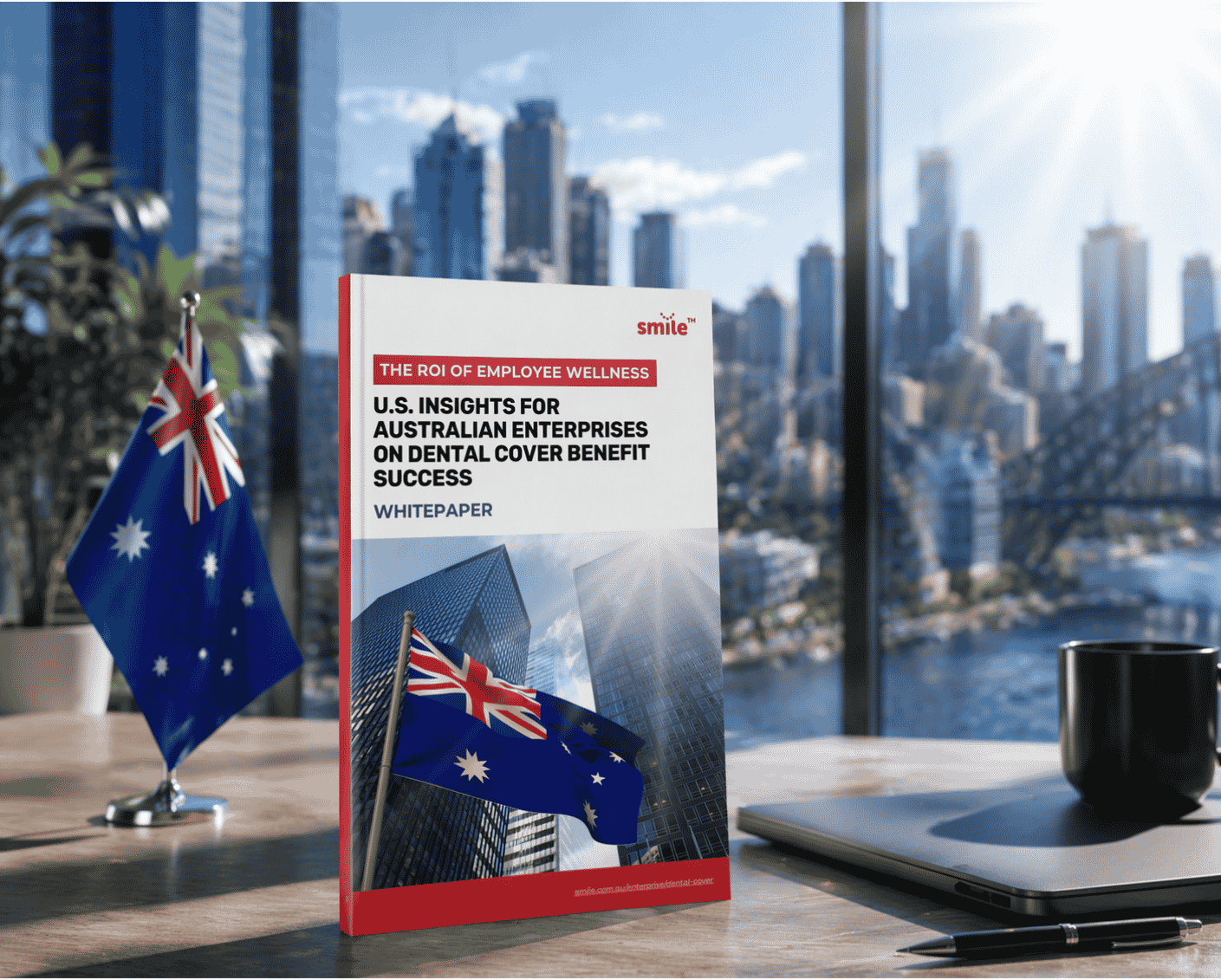
The Smile™ Enterprise Whitepaper adapts the U.S. blueprint for Australia: the data, the business case, and a step-by-step playbook to recover productivity and strengthen retention.
Poor oral health shows up at work every day through unplanned sick leave (absenteeism) and reduced focus while working in pain (presenteeism). Together, these drain productive time the organisation is already paying for. That productivity loss is estimated to be up to $7,500 per employee, per year, and the figure counts salary loss alone.
The real loss is higher once you add the cost of longer absences and reduced capacity from 50+ dental-related chronic conditions, talent loss and the recruitment that follows, lower confidence and engagement, workplace errors, and parental absenteeism.
The WHO puts the national cost to Australia at $8.7 billion dollars a year. In the U.S., 84% of employers provide employer-paid dental cover, and utilisation reaches 77% each year. At $99 per employee per year, FBT-exempt, that is a return of up to 76:1 on salary loss alone.
The Smile™ Enterprise Whitepaper adapts the U.S. blueprint for Australia: the data, the business case, and a step-by-step playbook to recover productivity and strengthen retention.
Poor oral health drains productive time through unplanned sick leave (absenteeism) and reduced focus while employees work in pain (presenteeism). That productivity loss is estimated at up to $7,500 per employee, per year, and the figure counts salary loss alone. The real loss is higher once you add the cost of longer absences and reduced capacity from 50+ dental-related chronic conditions, talent loss and the recruitment that follows, lower confidence and engagement, workplace errors, and parental absenteeism.
Employees working through dental pain experience an average 8% decline in performance. By reducing the cost barrier to preventive and reactive dental care, employer-paid dental cover reduces distraction, fatigue and avoidable productivity loss. Employees with dental cover are 186% more likely to attend routine dental visits, annually.
As modelled in the Smile™ Enterprise Whitepaper, employer-paid dental cover can deliver a return of up to 76:1, comparing the $99 annual cost per employee against a productivity loss of up to $7,500 per employee per year. That return reflects salary loss alone. It leaves out the cost of longer absences linked to 50+ dental-related chronic conditions, recruitment and onboarding of avoidable talent loss, workplace errors, parental absenteeism, and lost confidence and engagement. Every cost it excludes pushes the true return higher. The exact return will vary across employers, but the business case is clear.
Dental through extras is employee-paid, so coverage depends on each employee choosing it and being able to afford it. Those who do hold it still face waiting periods, treatment exclusions, annual benefit limits, out-of-pocket costs, high and rising annual cover costs, and extra cost to include family. This is why 2 in 3 Australian adults still avoid or delay dental care, mainly because of cost. Employers also have no visibility over who holds cover, whose family is included or who has let a policy lapse. Smile™ replaces optional availability with automatic, organisation-wide coverage: every employee and their family covered from Day 1, no purchase or enrolment, and no restrictions of any kind.
Yes. At $99 per employee per year, Smile™ Enterprise Dental Cover qualifies for the ATO's $300 Minor Benefits Exemption under Section 58P of the FBTAA 1986. It is under $300 per employee and provided on an infrequent, irregular basis — so there is zero FBT liability, no grossing-up, no reportable fringe benefit and no complex reporting. $99 is the whole cost.