Why Employers Should Be Paying Attention
When leaders think about workforce mental health, they think about workload, psychosocial hazards, flexibility and stigma. Almost none think about their employees’ oral health. Yet psychiatrists, periodontal researchers and public health bodies increasingly do.
Poor oral health is connected to more than 50 chronic conditions. Our first two reports in this series covered the cardiovascular and cancer links. This report covers the mental health evidence — and it cuts closer to daily working life than either of them, because unlike a heart attack or a diagnosis, this one shows up at work every single day: in confidence, focus, mood and participation.
Unlike most conditions in this series, the relationship between oral health and mental health runs in both directions. Poor oral health increases the risk of depression and anxiety, and depression and anxiety increase the risk of poor oral health. That makes it a cycle — and for HR, finance and executive leaders, cycles are exactly the kind of workforce risk worth interrupting early, because left alone they compound.
The Scale of Mental Ill-Health in Australia’s Workforce
Mental ill-health is not an edge-case HR issue. It is the single most expensive health problem inside Australian workplaces — and it is concentrated in the working-age population, not at the margins of it.
Anxiety is the most common mental disorder in Australia, affecting more than one in six adults in any 12-month period — and it peaks in the youngest working cohorts (ABS National Study of Mental Health and Wellbeing, 2020–22).
Workers aged 18–29 are almost 2.5 times as likely to experience high psychological distress as older colleagues — and highly distressed workers lose around 21.6 more workdays a year to distress-related absence and reduced capacity (National Health Survey analysis, 2020–21).
Absenteeism and presenteeism from mental ill-health cost Australian employers $13–17 billion a year (Productivity Commission). The typical mental-health workers’ compensation claim costs $25,650 — against $10,600 for all other claims — with a typical 16.2 weeks off work, versus 5.7 weeks for everything else.
In other words: the age groups most likely to carry a mental health condition are precisely the age groups sitting in your workforce. Set against that, the state of the nation’s mouths is the part employers have never been shown.
The State of Oral Health in Your Workforce
The three figures below summarise how widespread poor oral health is across the Australian working-age population, and why it goes unmanaged.
For most working-age Australians, dental sits outside Medicare, and whether routine visits happen depends on whether cover is in place. Without it, dental costs are unpredictable and care tends to be reactive rather than routine — and because poor oral health is usually painless until it is advanced, most affected employees have no idea they are carrying it. Public dental is not a realistic alternative: waiting times run from roughly 16.7 months in Victoria to 3.5 years in Tasmania.
What almost no employer has considered is what that avoidance may be doing to their workforce’s mental health — the very thing their wellbeing budget is trying to protect.
How Poor Oral Health and Mental Health Feed Each Other: The Science
The connection is not metaphorical, and — a structural difference from the cardiovascular and cancer reports in this series — it is not one-way. The evidence describes a cycle running through three well-documented pathways: one biological, one psychosocial, and one behavioural. Understanding all three matters, because enterprise dental cover interrupts the cycle at every point, not just one.
1Inflammation That Reaches the Brain
▼
Poor oral health keeps the body in a low-grade inflammatory state, raising markers including C-reactive protein (CRP), interleukin-6 (IL-6) and tumour necrosis factor-α (TNF-α). These are the same inflammatory markers consistently elevated in depression — the basis of the well-established inflammatory hypothesis of depression. Chronic oral inflammation contributes to neuroinflammation, disturbing the mood-regulating systems of the brain, and oral pathogens and their by-products have been implicated in changes along the hypothalamic-pituitary-adrenal (HPA) axis — the body’s stress-response system. This is the same inflammatory burden behind the cardiovascular and cancer links in our first two reports; here, it reaches the brain.
2Appearance, Pain and Social Confidence
▼
Poor oral health is one of the most visible and most stigmatised chronic conditions a person can carry. Bleeding gums, persistent bad breath, discoloured, drifting or missing teeth — these are not private symptoms. They shape how people speak, smile, eat and present themselves. More than 35% of Australian adults feel uncomfortable about their dental appearance, and researchers studying the poor oral health–mental health link point directly to this psychosocial toll: loss of confidence, reduced ability to socialise, and functional problems with eating and pain. Add chronic dental pain — which brings fatigue, irritability and disturbed sleep into the working day — and the pathway from mouth to mood needs very little explaining.
3The Behavioural Loop (Where the Cycle Closes)
▼
Mental ill-health pushes back on the mouth. Depression erodes the motivation behind daily brushing and flossing; people with depression are significantly less likely to attend the dentist, even when they know they need treatment. Many antidepressants cause dry mouth (xerostomia), a major driver of tooth decay. Anxiety brings jaw clenching and grinding, and dental anxiety keeps people out of the chair altogether. A landmark systematic review of 334,503 people found those with depression or anxiety had significantly more dental decay and greater tooth loss than the general population. Poor oral health then deepens the distress that caused the neglect — and the loop closes.
A one-way risk grows in a line. A cycle compounds. An employee whose low mood has kept them from the dentist for two years is developing the poor oral health that independently raises their risk of depression and anxiety — which further erodes the self-care and help-seeking that would break the pattern. Every month the cycle runs, both conditions get harder and more expensive to reverse. Accessible routine dental care is one of the few interventions that interrupts it at all three points at once.
The Mental Health Conditions Linked to Poor Oral Health
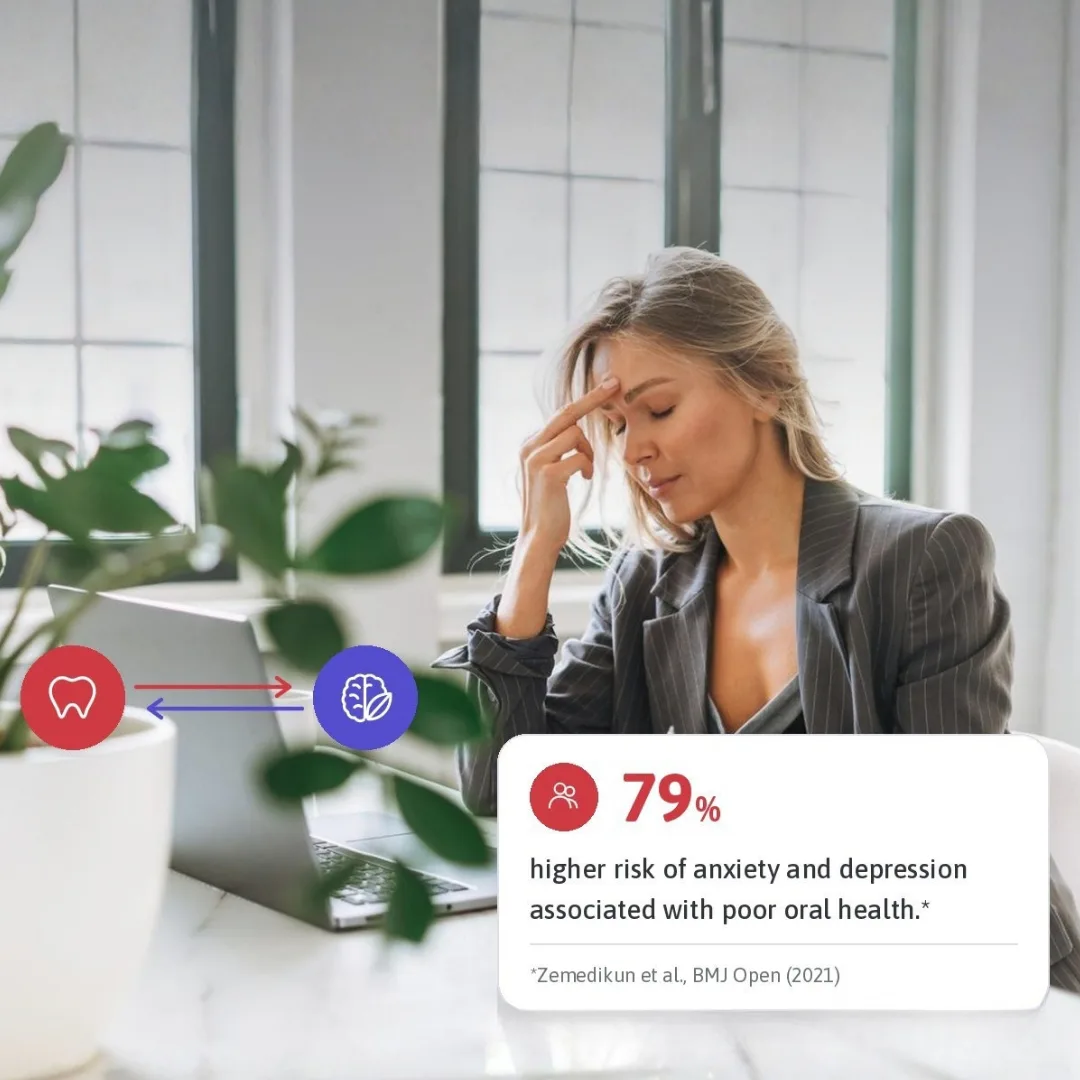
The most useful anchor is a large UK primary-care cohort study of 64,379 patients — average age 45, squarely in the working years — which compared people with a GP-recorded diagnosis of poor oral health against matched patients without one. At study entry, those with poor oral health were 79% more likely to have mental ill-health, including depression, anxiety and serious mental illness. Followed forward over time, those without an existing diagnosis went on to develop mental ill-health at a 37% higher rate than their peers. The associations examined below concentrate in specific conditions.
higher likelihood of mental ill-health with poor oral health — and a +37% higher risk of newly developing it over follow-up.
Zemedikun et al., BMJ Open (2021), 64,379 UK primary-care patients, average age 45
Depression
▼
Depression is more than low mood. It is a persistent condition that drains energy, motivation, concentration and self-worth, typically for weeks or months at a time. In the workforce it is the mental health condition most strongly tied to absence, reduced output and departure — and it is most prevalent in the under-35s, not at the end of careers.
The oral health association here is the most studied of all. A meta-analysis in the Journal of Clinical Periodontology found people with poor oral health had 70% higher odds of depression, and a nationwide cohort study following patients for 5 to 11 years found those with poor oral health were nearly twice as likely to go on to develop depression — evidence the mouth precedes the mood, not just the reverse. In the other direction, people with depression carry measurably more decay and tooth loss, closing the loop described above.
higher odds of depression in people with poor oral health — and close to 2× the risk of developing depression over 5–11 years of follow-up.
Zheng et al., J Clin Periodontol (2021); Hsu et al., Medicine (2015), nationwide cohort
Depression is the single largest driver of mental-health absence and presenteeism in Australian workplaces — depression alone is estimated to cost employers around $6.3 billion a year. A modifiable risk factor that lifts depression odds by 70%, sitting untreated in 3 in 10 adults, is a workforce exposure most organisations have never priced.
Anxiety Disorders
▼
Anxiety disorders — generalised anxiety, social anxiety and related conditions — involve persistent, excessive worry that interferes with daily functioning. Anxiety is Australia’s most common mental disorder, and it peaks in the youngest working cohorts: the employees earliest in their careers and most expensive to lose.
The same 2021 meta-analysis found poor oral health associated with 36% higher odds of anxiety, with researchers pointing to both the shared inflammatory and stress-hormone (HPA axis) biology and the health-behaviour changes anxiety drives. The relationship is again bidirectional: anxiety fuels jaw clenching, grinding and dental avoidance, each of which damages oral health directly.
higher odds of anxiety in people with poor oral health.
Zheng et al., J Clin Periodontol (2021), meta-analysis
Anxiety is the condition your youngest employees are most likely to be carrying — almost 2 in 5 Australians aged 16–24 had a mental disorder in the past 12 months, with anxiety the most common. These are also the employees least likely to have dental cover of any kind, and most exposed to the cost barriers that keep 2 in 3 Australians away from the dentist.
Panic Disorder and Panic Attacks
▼
Panic disorder involves recurrent, unexpected panic attacks — sudden surges of overwhelming fear with physical symptoms such as a racing heart, chest tightness and breathlessness — plus persistent worry about the next one. At work, it drives sudden absence, avoidance of meetings, travel and presentations, and quiet withdrawal from visible roles.
In an analysis of US national health examination data focused specifically on young adults, those with panic disorder had threefold higher odds of periodontal (gum) disease than those without — a relationship that persisted after adjusting for smoking. It is one of the strongest single associations in the entire oral–mental health literature, and it sits in exactly the age bracket employers are working hardest to attract and retain.
higher odds of poor oral health in young adults with panic disorder (OR 3.07).
NHANES 1999–2004 analysis of young adults, J Affect Disord (2013)
Panic disorder is easy for employers to miss: it presents as unexplained sick days, declined meetings and sudden exits from high-visibility roles. A threefold oral-health association in young adults means the dental chair is one of the few places this at-risk group reliably shows up — when cost stops keeping them away.
Stress and Burnout
▼
Workplace stress is not a diagnosis, but sustained psychological distress is the soil the diagnosable conditions grow in — and it is already a regulated employer responsibility in Australia under psychosocial hazard rules.
Chronic stress elevates cortisol, which suppresses immune function in gum tissue and accelerates periodontal breakdown — one reason stress has long been recognised as a contributor to poor oral health progression. Stress also drives the behaviours that damage teeth directly: grinding, clenching, poor diet, smoking and skipped dental visits. Chronic workplace stress and oral health are therefore not separate wellbeing topics — one degrades the other, on a loop.
Self-Esteem, Confidence and Social Participation
▼
Not every impact needs a diagnosis. More than 35% of Australian adults feel uncomfortable about their dental appearance — the kind of self-consciousness that quietens people in meetings, keeps cameras off, and pulls capable employees back from client-facing and leadership-track roles. Studies of tooth loss and mental wellbeing find the more natural teeth a person is missing, the higher their anxiety and depressive symptoms — and, tellingly, people whose missing teeth had been fully replaced showed measurably lower anxiety and depression than those left untreated. Treatment, in other words, moves the needle back.
Warning Signs Employees Should Not Ignore
Communicate these to your workforce as part of any health awareness program. Because this cycle runs in both directions, the signs worth flagging include both the dental and the behavioural:
A Workforce Risk Factor the Wellbeing Budget Doesn’t Reach
Most organisations already invest in mental health — an EAP, a wellbeing platform, mental health days, psychological-safety programs under psychosocial hazard rules. These matter, and this report is not an argument for doing less of any of them.
But the evidence in the sections above points to something those programs weren’t designed to reach: poor oral health is associated with measurably higher rates of depression, anxiety and panic disorder, through the biological, psychosocial and behavioural cycle set out earlier. It is a common, preventable, physical risk factor sitting upstream of the outcomes the wellbeing budget is trying to protect — and it goes almost entirely unaddressed, because it has never been treated as a mental health input.
Routine annual dental care is what modifies it. Regular check-ups each year reduce the chronic inflammation associated with higher depression and anxiety odds, treat the pain and visible damage that erode confidence, and remove a recurring financial stressor at home. None of that replaces mental health support — it works alongside it, on a risk factor the rest of the portfolio can’t touch.
What This Actually Costs
Mental ill-health is the most expensive health category inside Australian workplaces. Absenteeism and presenteeism tied to it cost employers between $13 billion and $17 billion a year. When it results in a claim, the numbers are steep: a typical mental-health workers’ compensation claim runs to $25,650, against $10,600 for everything else, and keeps people off work for a typical 16.2 weeks, versus 5.7. These are the longest, costliest absences an employer faces — and they land hardest on the under-35s, the same cohort most likely to be carrying a condition and most expensive to replace.
Before any of that, though, the cost lands on talent: whether good people join, and whether they stay. Replacing one employee costs 30% to 200% of their annual salary once recruitment, onboarding and lost ramp-up are counted. A benefit only shifts if employees feel it — and dental is one of the few that does, because it reaches partners and children and gets used routinely, not only in a crisis.
Where It Surfaces in the Working Day
The cost of poor oral health rarely announces itself. It surfaces in ordinary moments across a working day, and each one traces back to whether an employee has care they can afford to use.
It shapes whether people join and stay: 78% of Australian workers expect their employer to take care of their health and wellbeing, in and outside of work. Dental gives employers a practical way to make that care tangible — a benefit employees and their families feel at every check-up, not a line in a policy document.
It follows people home as financial strain: Benefits employees rarely use do little for engagement. Meanwhile, unpredictable, potentially multi-thousand-dollar dental costs add to cost-of-living pressure — contributing to delayed care, financial stress and employee dissatisfaction. Financial stress is itself a well-recognised driver of anxiety and low mood, which makes the dental gap a mental-health gap twice over.
It quietens people in the room: More than 35% of Australian adults feel uncomfortable about their dental appearance — the kind of self-consciousness that quietens people in meetings and client-facing roles. Poor oral health also brings pain-driven fatigue and irritability into the working day.
It sits at desks, working at half-capacity: Between 28% and 50% of employees turn up to work with conditions like toothache or jaw pain, and working through dental pain cuts performance by around 8% — in concentration, judgement and error rates. Mental-health presenteeism stacks on top: highly distressed workers lose around 21.6 more workdays’ worth of capacity a year.
It pulls people out of the building — their own days and their family’s: Dental issues are a notable cause of sickness-related absence, accounting for up to 27% of sickness-related absences internationally. On top of that sits parental absenteeism, resulting from almost 2.04 million school days in Australia missed a year due to poor oral health.
And when it escalates, it keeps people out longest: Poor oral health is linked to 50+ dental-related chronic conditions, including depression, anxiety, heart attack, stroke and cancer. These wider health impacts can contribute to more serious health events, longer absences and reduced workforce capacity — and mental-health absences run longest of all, at a typical 16.2 weeks per compensation claim.
Cumulative Annual Talent and Productivity Loss Due to Poor Oral Health
Both costs compound quietly across a workforce, and neither appears as a line item. Talent loss is the larger and less visible of the two, while the up-to $7,500 per employee per year productivity figure counts only the salary lost to absenteeism and presenteeism from dental pain — it leaves out every mental-health cost documented in this report.
See what avoidable talent loss linked to poor oral health is costing your organisation, based on your workforce size and salary profile.
See what lost productivity from poor oral health is costing your workforce, and the return enterprise dental cover delivers against it.
Why Dental Is the Wellbeing Benefit That Gets Used
Dental is a universal, recurring and expensive need. Everyone has teeth, everyone needs care twice a year for life, and when something goes wrong the cost is unpredictable and can run into thousands. That combination is rare in a benefits portfolio — and it’s why dental rewards enterprise cover in a way most wellbeing does not.
Enterprise cover means the business funds 100% of the membership, so there’s no high, rising annual cover cost for the employee to weigh up. Smile™ then reduces and caps treatment fees across 4,000+ dentists nationwide. For the employee, that’s protection from unpredictable dental costs — and one less source of the financial stress this report has traced straight into anxiety and low mood. Fund it for everyone at once, and attendance follows:
The three figures below show what happens to dental utilisation when the employer pays — the mechanism that turns cover on paper into attendance in the chair.
Utilisation is where dental stands apart. Under employer-paid arrangements, up to 77% of employees use their dental cover in a year, and employees with cover are 186% more likely to attend a routine check-up. That matters here because attendance is the mechanism: each visit is a chance to reduce the inflammation associated with higher depression and anxiety odds, treat the pain and visible damage behind lost confidence, and ease recurring financial pressure at home. A dental check-up is also a non-stigmatised, physical entry point into care — one many people will keep even during a low patch, when reaching out for support feels hardest.
Where Extras Cover and Wellness Perks Fall Short, and Smile™ Doesn’t
That’s why 2 in 3 Australian adults still avoid or delay dental care, and why a benefit some employees happen to hold isn’t the same as a workforce with dental access. Coverage stays uneven by design — and the employees under the most financial and psychological strain are the likeliest to sit outside it.
Smile™ replaces optional availability with automatic, organisation-wide cover:
- Every employee and their family covered from Day 1
- No purchase or enrolment
- No waiting periods
- No treatment exclusions
- No annual limits
- 100% dedicated to dental
Employees who already hold extras cover can exit and save the annual cover cost, or keep it and pay the lower of the two reduced fees. Either way, your team wins.
The Payoff, Across the Business
The table below maps each business lever this report has touched to the way enterprise dental cover moves it.
| Business lever | How enterprise dental cover moves it |
|---|---|
| Talent attraction | 78% of Australian workers expect their employer to take care of their health and wellbeing, in and outside of work. Enterprise dental cover answers that expectation with a family-inclusive benefit that differentiates an offer in a way a discount cannot. |
| Retention | A benefit employees and families genuinely feel, addressing avoidable talent loss against replacement costs of 30% to 200% of annual salary. Felt benefits are the ones that retain. |
| Mental health and confidence | Interrupts the oral health–mental health cycle at all three points: less inflammation, less pain and appearance-related distress, and restored routine care. Addresses the dental-appearance discomfort more than 35% of adults carry into meetings and client-facing work. |
| Employee satisfaction and engagement | Reduced and capped fees ease a real cost-of-living pressure — removing a documented source of financial stress and the anxiety that follows it — and every check-up is repeated, visible evidence the employer has invested in the whole family. |
| Utilisation | Up to 77% of employees use their dental cover in a year under employer-paid arrangements — against the low single-digit utilisation typical of EAPs. |
| Productivity | Fewer people working through pain; sharper focus, judgement and fewer costly errors against the 8% performance drop seen with dental pain. |
| Absenteeism and presenteeism | Fewer dental-driven sick days and, through family cover, fewer lost workdays to dependants’ dental needs. |
| Health-cost exposure | Prevention at $99 per year heads off conditions that cost thousands per affected employee and reduces exposure to the 50+ dental-related chronic conditions linked to poor oral health — including the depression and anxiety documented in this report. |
| Tax overhead | Fully exempt from FBT under the ATO’s $300 Minor Benefits Exemption (Section 58P). No grossing up, no reporting, no liability. |
| Return on Investment (ROI) | At $99 per employee per year against a productivity loss of up to $7,500, the return reaches up to 76:1 on salary loss alone — and improves once the cost of turnover, recruitment, errors and lost confidence are added in. |
Find out how Smile™ Enterprise Dental Cover strengthens mental health and wellbeing across your workforce.
Sources & References (32)▼
- 1Zemedikun DT et al. Burden of chronic diseases associated with periodontal diseases: a retrospective cohort study using UK primary care data (64,379 patients, average age 45). BMJ Open, 2021 bmjopen.bmj.com
- 2Zheng DX et al. Periodontal disease and emotional disorders: A meta-analysis. J Clin Periodontol, 2021 onlinelibrary.wiley.com
- 3Hsu CC et al. Association of periodontitis and subsequent depression: a nationwide population-based study. Medicine, 2015 pubmed.ncbi.nlm.nih.gov
- 4Associations of depressive and anxiety disorders with periodontal disease prevalence in young adults (panic disorder OR 3.07) — NHANES 1999–2004. J Psychosom Res, 2013 pubmed.ncbi.nlm.nih.gov
- 5Kisely S et al. The oral health of people with anxiety and depressive disorders — a systematic review and meta-analysis (334,503 subjects). J Affect Disord, 2016 pubmed.ncbi.nlm.nih.gov
- 6Kisely S et al. Prevalence of dental disorders among people with mental illness: An umbrella review. Aust N Z J Psychiatry, 2021 pubmed.ncbi.nlm.nih.gov
- 7Ball J, Darby I. Mental health and periodontal and peri-implant diseases. Periodontology 2000, 2022 onlinelibrary.wiley.com
- 8Martínez M et al. The role of the oral microbiota related to periodontal diseases in anxiety, mood and trauma- and stress-related disorders. Front Psychiatry, 2022 frontiersin.org
- 9Oral health, anxiety symptoms and depressive symptoms: findings from SHARE. 2024 pmc.ncbi.nlm.nih.gov
- 10Mental Health, Socioeconomic Position, and Oral Health: A Path Analysis — CDC Preventing Chronic Disease, 2024 cdc.gov
- 11National Study of Mental Health and Wellbeing, 2020–2022 — ABS abs.gov.au
- 12Mental Health Inquiry Report (cost of mental ill-health; absenteeism and presenteeism $13–17b; claims data; 75% onset before 25) — Productivity Commission, 2020 pc.gov.au
- 13State of Workplace Mental Health in Australia ($10.9b untreated mental health conditions) — Beyond Blue / TNS / PwC qhrc.qld.gov.au
- 14Workforce Psychological Distress and Absenteeism in Australia (18–29s OR 2.45; 21.56 loss days). J Occup Environ Med, 2024 pubmed.ncbi.nlm.nih.gov
- 15Oral health and dental care in Australia (2025) — AIHW aihw.gov.au
- 1667% delay or avoid dental care — ABC News abc.net.au
- 17$8.7B annual employer productivity loss — WHO Oral Health Country Profile (Australia) who.int
- 183 in 10 moderate–severe oral disease / 33% untreated decay — Oral Health of Australian Adults (ResearchGate) researchgate.net
- 1988,600 preventable dental hospitalisations 2023–24 — AIHW aihw.gov.au
- 20Root canals/crowns can exceed $4,000 out-of-pocket — Smile dental fees smile.com.au
- 2114-day absenteeism baseline — Sedgwick 2023 Absence Management Report sedgwick.com
- 228% performance decline working through dental pain — J-Stage (Industrial Health) jstage.jst.go.jp
- 2328%–50% report to work with dental pain — PMC pmc.ncbi.nlm.nih.gov
- 24186% more likely to attend with cover (AU) — AIHW aihw.gov.au
- 2577% employer-paid utilisation — Guardian 12th Annual Workplace Benefits Study guardiangroupbenefits.com
- 2695% of 500+ employers (84% overall) provide cover — Employer Advisor employeradvisor.com
- 27Replacement cost 30–200% of salary — Employee turnover (Wikipedia) en.wikipedia.org
- 2835%+ uncomfortable about dental appearance — PMC pmc.ncbi.nlm.nih.gov
- 2925–36% fewer hospital admissions (diabetes/CVD) — PubMed pubmed.ncbi.nlm.nih.gov
- 3050+ chronic conditions linked to poor oral health — Sunstar GUM sunstargum.com
- 31$300 Minor Benefits Exemption (minor + infrequent) — ATO FBT guidance ato.gov.au
- 32Minor Benefits Exemption ruling (s58P, TR 2007/12) — ATO ato.gov.au